

The 'Five Out' Offence — A Junior Coaching Guide
The 'Five Out' is a most basic offensive principle in basketball. It's a very simple idea and therefore perfect for young players. There are two main facets: spreading the court, and moving after every pass.
Principle #1: Spread the Court 🏀
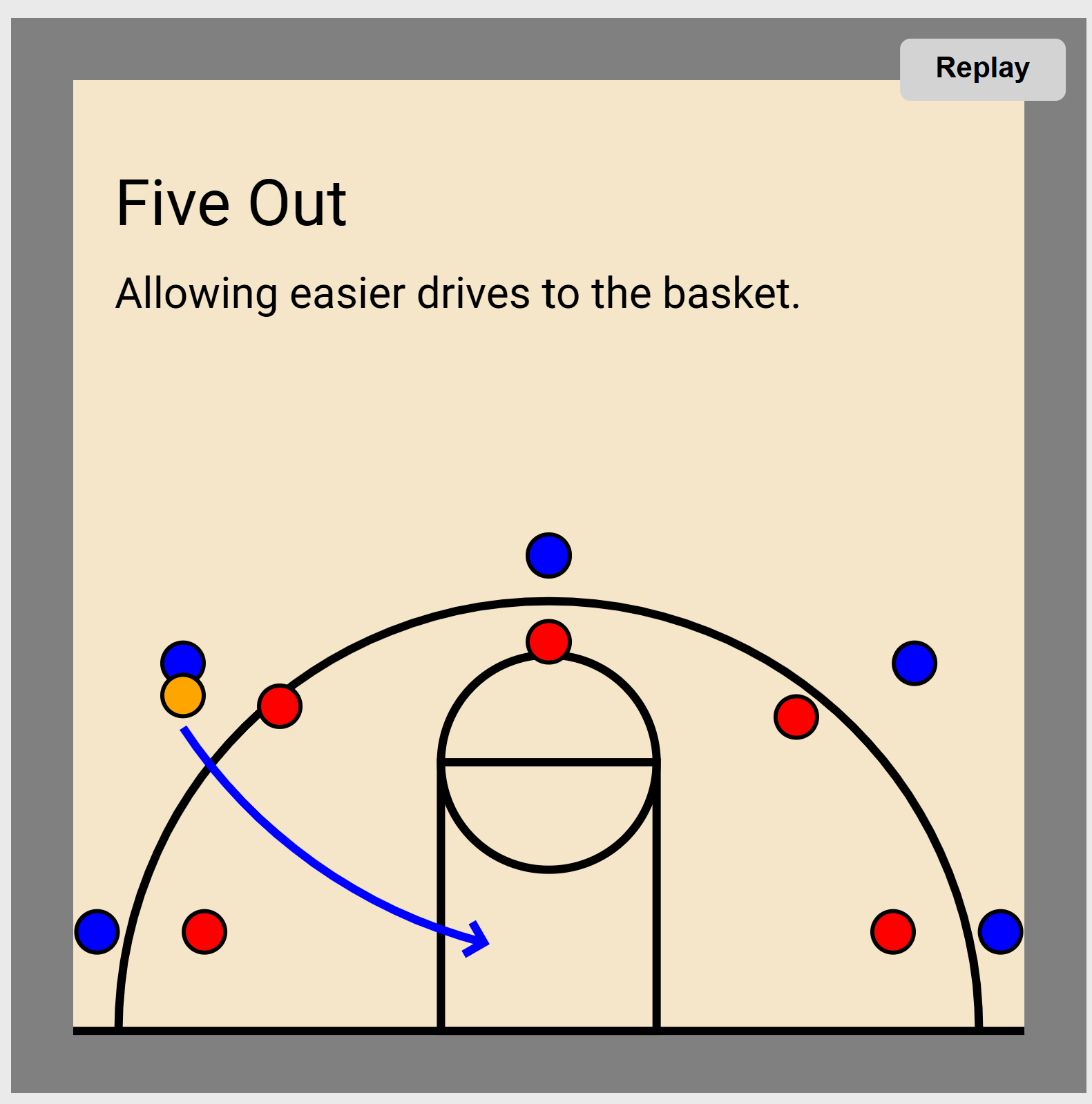
All five players spread out evenly beyond the 3-point line, dragging the defence out of the keyway. This opens up driving lanes to the basket — perfect for young players who are better at driving than shooting from distance.
- 🎯Spreading the defence out makes it easier to drive into the keyway. With no help defender clogging the lane, one-on-one drives become much more effective.
- 🛡️Makes it much harder to double-team because every defender is stretched out guarding their player on the perimeter.
- ⭐Ideal for juniors who haven't yet developed strong outside shooting but excel at driving to the basket.
Principle #2: Pass & Move — The Keyway Cut ✂️
The golden rule of Five Out: if you pass the ball, you must DO something. The most common action is to cut through the keyway looking for a return pass. If no pass comes, the cutter continues to the weak side and the remaining players rotate to fill the gaps.
- ✂️The passer cuts hard through the key, looking for a quick return pass for a lay-up. This movement forces the defence to react — they can't just sit back.
- 🔄Weak-side players fill the gaps — the player at the top slides over and the wing fills the vacant spot. This keeps the Five Out shape intact and ready for the next action.
- 💡Teaches young players to never stand still after passing. This is one of the most important habits to build early!
Principle #3: Pass & Screen — On-Ball Screen 🧱
Instead of cutting, the passer can run directly at the ball handler's defender and set a screen on the ball. This creates a two-on-one situation — the ball handler can drive past the screen while the defender is stuck behind it.
- 🧱After passing, the player runs to set a pick on the ball handler's defender. The screener must be stationary before contact — feet set, hands in!
- 🏃The ball handler drives hard off the screen into the open lane. With the Five Out spacing, there's no help defender waiting in the key — it's a clear path to the basket!
- 🎓Great for teaching teamwork and unselfishness — the screener sacrifices their own scoring chance to create an opportunity for a teammate.
Principle #4: Pass & Screen — Off-Ball Screen 🎭
The third option after passing is to set a screen away from the ball. This frees up a teammate who can cut to an open spot — and it's much harder for the defence to help because the action happens on the weak side.
- 🎭The passer screens a teammate's defender on the opposite side of the court. The screened player cuts into the open space near the key.
- 👀Because the action is away from the ball, defenders often lose sight of the screen — creating surprise advantages and open looks.
- 📈A more advanced concept — introduce this once your players are comfortable with keyway cuts and on-ball screens. It teaches players to be active even when they're far from the ball.
In Summary
1. Spread all five players beyond the 3-point line to open up driving lanes.
2. After every pass, the passer must DO something — never stand still!
3. Cut through the keyway looking for a return pass and lay-up.
4. Set an on-ball screen to create a two-on-one at the point of attack.
5. Set an off-ball screen to free up a teammate away from the ball.
A simple offensive set up easily understood by young players: spread out and if you pass the ball — move!